
Tankless Water Heater Services · Ashburn, VA
Tankless Water Heater Services in Ashburn, VA
Tankless units do one thing very well: they do not run out. What they ask in return is a bigger gas supply, a different vent, and annual descaling that is not optional on water like ours.
Whether that trade is worth it depends on the house and on how the household actually uses hot water.
Whether tankless suits a house on Loudoun Water
The honest starting point is the water, because it is the factor most sales conversations skip.
At 4.9 to 9.9 grains per gallon, the range the utility reports for this system sits in its moderately hard to hard band. A tank copes by dropping sediment to the bottom where it mostly sits. A tankless unit heats water in a narrow heat exchanger, so scale forms directly on the surface doing the work.
That is not a reason to avoid tankless here. It is a reason to treat annual descaling as part of owning one rather than as an optional service, and to budget for it from the start.
Swapping a tank for tankless: three systems usually change
Replacing a tank with a tankless unit is not a swap. Three systems usually need changing and that is where the cost sits.
What has to change
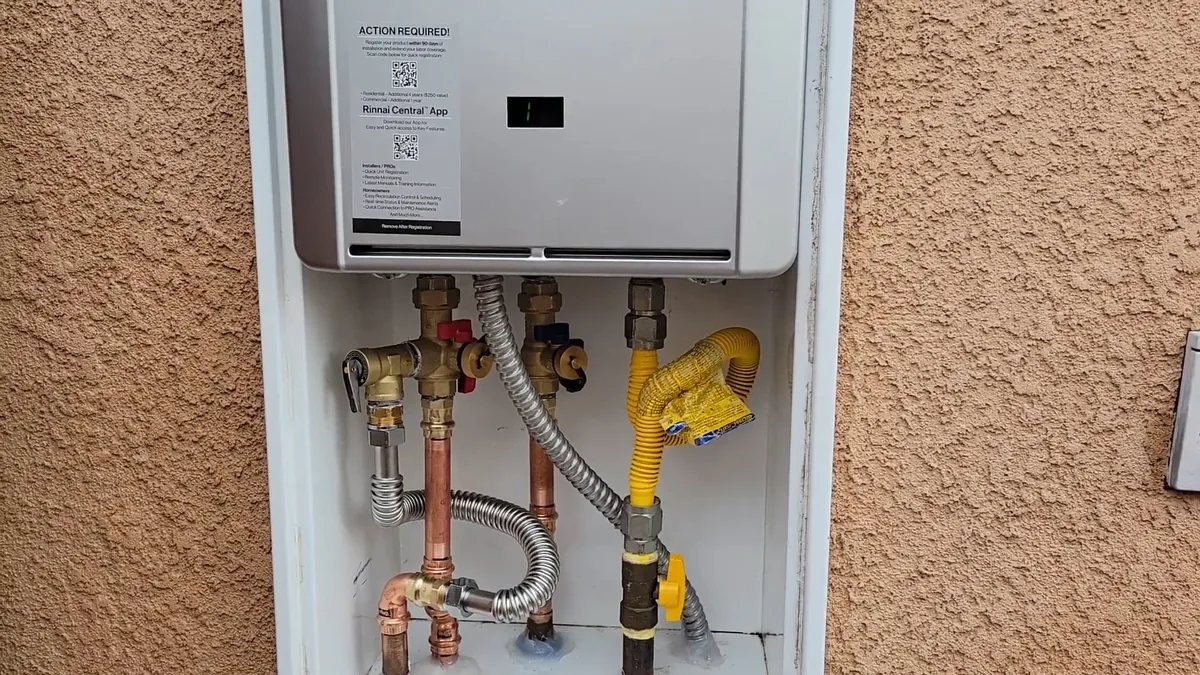
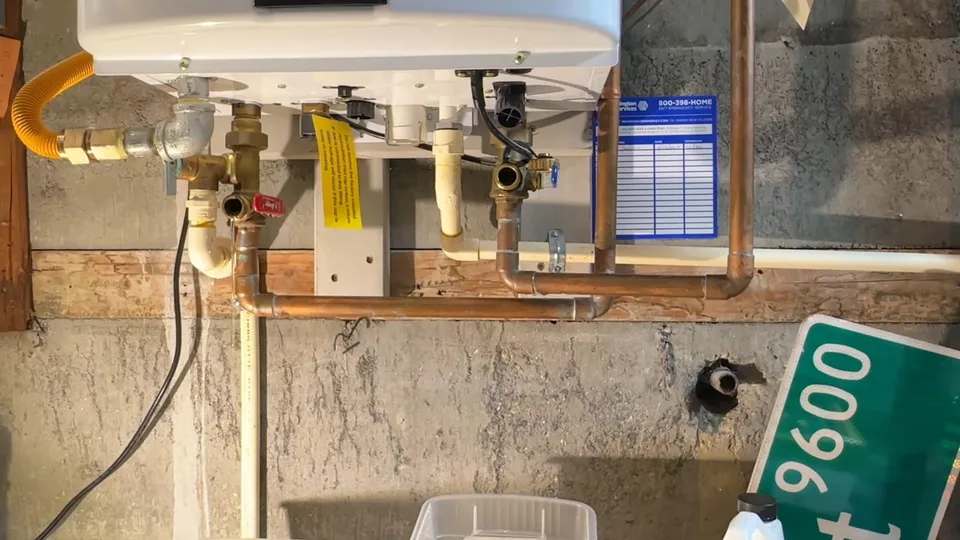
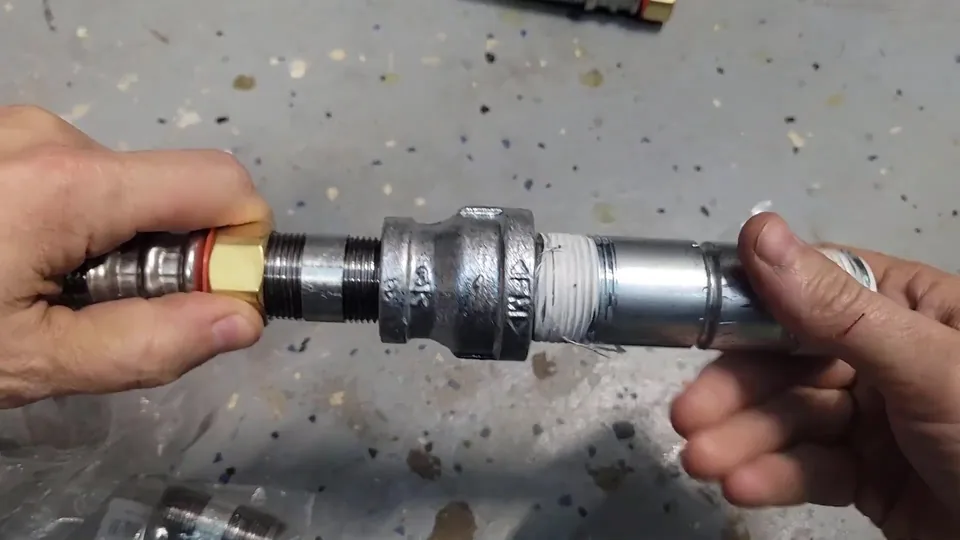
- Gas supply: a tankless unit fires at a far higher rate than a tank, so the existing line is often undersized and has to be upsized back to the meter
- Venting: tankless units use a sealed, fan-assisted vent, and the material depends on whether the unit is condensing or non-condensing
- Electrical: even a gas unit needs power for the fan and controls, so a circuit is usually required where none existed
- Condensate: a condensing unit produces acidic condensate that needs a drain and often a neutraliser
- Mounting: the unit goes on a wall rather than a floor, which frees space but needs the right wall
None of that is difficult. All of it is why the installed price is roughly double a like-for-like tank replacement, and why the gas supply work often overlaps with our gas piping service.
Descaling, and why it is not optional here
Descaling circulates a mild acid solution through the heat exchanger to dissolve mineral buildup. On our water it is an annual job.
Skipping it is gradual rather than dramatic. The unit takes longer to reach temperature, the outlet temperature starts fluctuating during a shower, and eventually the unit throws a fault code and shuts down.
Most units have isolation valves fitted at installation specifically to make this straightforward. If yours does not have them, fitting them during the first service pays for itself.
A point-of-use unit for a far bathroom
A small undersink tankless unit solves a specific problem: a fixture a long way from the heater, where you run the tap for thirty seconds before anything warm arrives.
It is not a whole-house solution and it is not sold as one. It sits under the basin, heats the water for that fixture only, and removes the wait and the wasted water.
The usual candidates are a powder room added during a renovation, a basement bathroom at the far end of the run, or a wet bar. In each case the alternative is a recirculation loop, which is a bigger piece of work.
These are small electric units in most cases, so the main constraint is whether a suitable circuit can reach the location.
Where tankless does not pay off
Worth saying plainly, because the cases exist and nobody benefits from finding out afterwards.
Cases where a tank is the better answer
Low hot water use overall, where the standby loss a tankless unit avoids was never large enough to recover the installation cost.
An electric house with no gas supply, where an electric tankless unit large enough for a whole house needs electrical capacity most homes do not have spare.
A household that will not keep up with annual descaling, where a tank is simply more forgiving of being ignored.
A straight like-for-like replacement under time pressure, where the conversion work is not realistic in the window available.
Pooled industry call data shows tankless enquiries convert less often than tank work, and a fair part of that is people discovering the conversion scope partway through. Knowing it up front is better for everyone.
What a tankless conversion costs
Installation runs roughly $2,500 to $4,800. What moves it inside that range is the three systems above.
Gas line sizing is usually the largest variable, because upsizing back to the meter depends entirely on the run length and what it passes through. Electrical panel capacity is the second, and exterior venting configuration the third.
Annual descaling is a separate, much smaller recurring cost, and it is worth factoring in at the point of deciding rather than discovering later.
Tankless questions worth asking first
Does a tankless unit make sense with Ashburn's water hardness?
It can, provided you treat annual descaling as part of owning one rather than as an optional extra.
The supply here measures 4.9 to 9.9 grains per gallon on the utility's own scale. A tank copes with that by dropping sediment to the bottom where it mostly sits. A tankless unit heats water in a narrow heat exchanger, so scale builds up directly on the surface doing the work.
That is not a reason to avoid tankless here. It is a reason to budget for annual service from the start, and to have isolation valves fitted at installation so the descale is straightforward every year after.
Is a point-of-use tankless unit worth it for a far bathroom?
For the specific problem of a fixture a long way from the heater, yes. If you run a tap for thirty seconds before anything warm arrives, a small undersink unit removes both the wait and the wasted water.
It is not a whole-house solution and is not sold as one. It heats water for that fixture only. Typical candidates are a powder room added during a renovation, a basement bathroom at the end of a long run, or a wet bar.
The alternative for the same problem is a recirculation loop, which is a larger piece of work. The main constraint on a point-of-use unit is usually whether a suitable electrical circuit can reach the location.
How often does a tankless unit need descaling here?
Annually, on water in this hardness range.
Descaling circulates a mild acid solution through the heat exchanger to dissolve mineral buildup. Skipping it is gradual rather than dramatic: the unit takes longer to reach temperature, the outlet temperature starts fluctuating mid-shower, and eventually it throws a fault code and shuts down.
Most units have isolation valves fitted at installation specifically to make this straightforward. If yours does not have them, fitting them during the first service pays for itself quickly.
Why does a tankless conversion cost more than a tank swap?
Because it is not a swap. Three systems usually have to change, and that is where the money goes.
Gas supply is the largest variable: a tankless unit fires at a much higher rate than a tank, so the existing line is often undersized and needs upsizing back toward the meter. Venting changes to a sealed, fan-assisted arrangement whose material depends on whether the unit condenses. Electrical supply is needed for the fan and controls even on a gas unit, and a condensing unit needs a condensate drain.
Installation runs roughly $2,500 to $4,800 against $1,200 to $2,800 for a tank replacement, and that gap is almost entirely those three systems.
Does a tankless conversion need both a plumbing and a gas permit?
Usually both, because a conversion changes the water side and the fuel side at once. The two permits come from different desks in Loudoun County, so they are applied for as two items rather than one.
Plan review is the part that catches people out on this job. Since October 2025 a residential fuel gas application can be held for drawings, which pushes the start date out by weeks rather than days.
Treat a conversion as a scheduled project rather than a same-week item, and confirm the current requirements for your specific job on 703-777-0220.
Thinking about going tankless in Ashburn?
Tell us where the current unit sits, what fuel it uses and how many bathrooms draw at once. That is usually enough to say whether a conversion makes sense for your house.