
Water Leak Detection Services · Ashburn, VA
Water Leak Detection Services in Ashburn, VA
The usual version of this call is a water bill that went up with nothing visible anywhere in the house. No damp patch, no sound, no puddle. Just a number that does not match how much water anyone used.
Finding exactly where it is, before anything gets opened, is the part that keeps the repair small.
A bill that jumped with nothing to see
A concealed leak announces itself indirectly. The water is going somewhere, so something changes, but the change is rarely where the leak is.
What people notice first
- A water bill that rose with no change in how much the household used
- A hot spot on a floor, or a cold damp patch that does not dry
- The sound of running water when every tap is closed
- A musty smell in one room that does not clear with ventilation
- Reduced pressure at a fixture that used to be fine
- A water heater or boiler cycling more often than it should
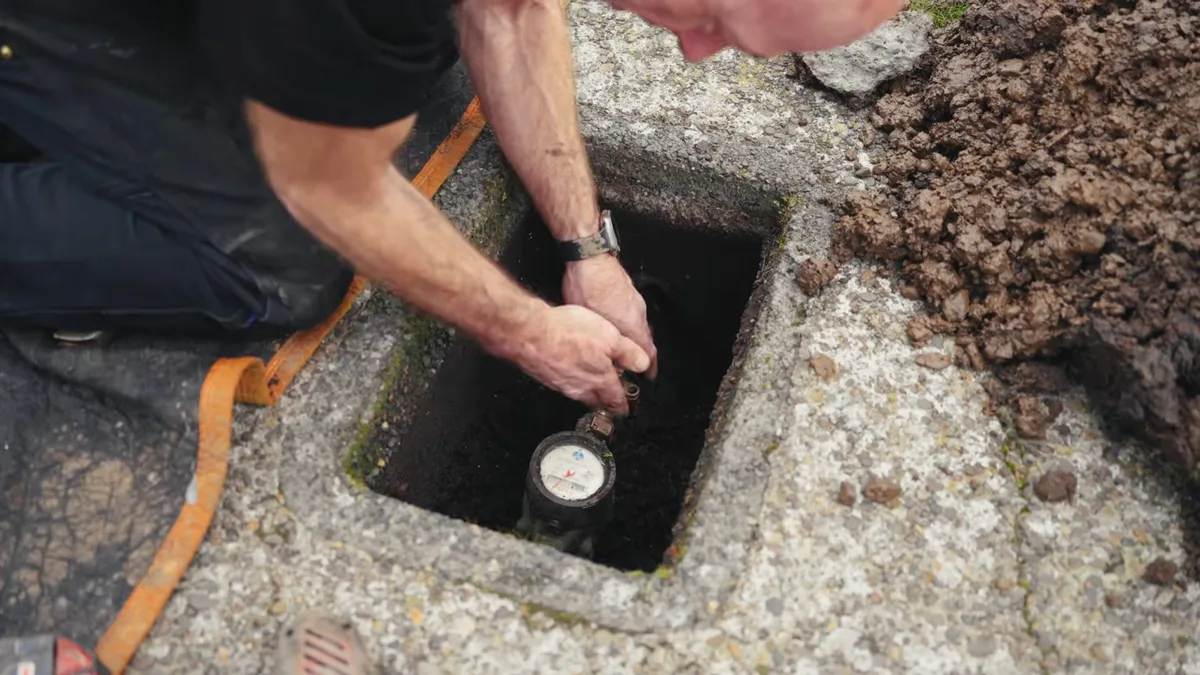
Any one of those is worth a meter test, which takes minutes and tells you whether water is leaving the system at all.
The meter test is the least expensive diagnostic there is. Shut every fixture, watch the meter, and if the dial still creeps you have confirmed a leak before paying anyone to look for it.
If water is running or spreading right now
C
l
o
s
e
t
h
e
m
a
i
n
s
h
u
t
o
f
f
f
i
r
s
t
,
t
h
e
n
c
a
l
l
.
W
a
t
e
r
m
o
v
i
n
g
a
c
r
o
s
s
a
f
l
o
o
r
o
r
d
o
w
n
a
c
e
i
l
i
n
g
i
s
a
n
u
r
g
e
n
t
v
i
s
i
t
r
a
t
h
e
r
t
h
a
n
s
o
m
e
t
h
i
n
g
t
o
b
o
o
k
f
o
r
n
e
x
t
w
e
e
k
.
L
e
a
v
e
t
h
e
m
a
i
n
c
l
o
s
e
d
u
n
t
i
l
a
p
l
u
m
b
e
r
h
a
s
s
e
e
n
t
h
e
l
i
n
e
.
How a concealed leak is actually located
Once the meter confirms water is escaping, the job becomes narrowing the search so the opening is small. A hidden leak inspection uses three main methods, and they suit different situations.
| Method | What it does | Best suited to |
|---|---|---|
| Acoustic | Amplifies the sound water makes escaping under pressure | Supply lines in walls, under floors and underground |
| Thermal imaging | Reads surface temperature differences | Hot water lines, and wet material behind a finished surface |
| Electronic pressure isolation | Shuts sections in turn to see which loses pressure | Narrowing which branch or zone holds the leak |
| Camera | Looks inside a drain or sewer line | Waste lines, where there is no pressure to listen for |
Most jobs use two of these together. Isolation narrows it to a zone, then acoustic or thermal work pinpoints the spot inside that zone.
The point of all of it is a smaller repair. Opening one square of drywall where the leak actually is costs far less than opening a wall to look.
Ceiling stains and thermal imaging: where the water really is
A stain on a ceiling is the most common visible leak, and the place the water appears is usually not above the leak. Water runs along a joist or a pipe until it finds somewhere to drop.
That is why chasing a ceiling stain upward by opening drywall tends to produce several holes and no answer. Thermal imaging reads the wet area rather than the visible mark, which is a different shape.
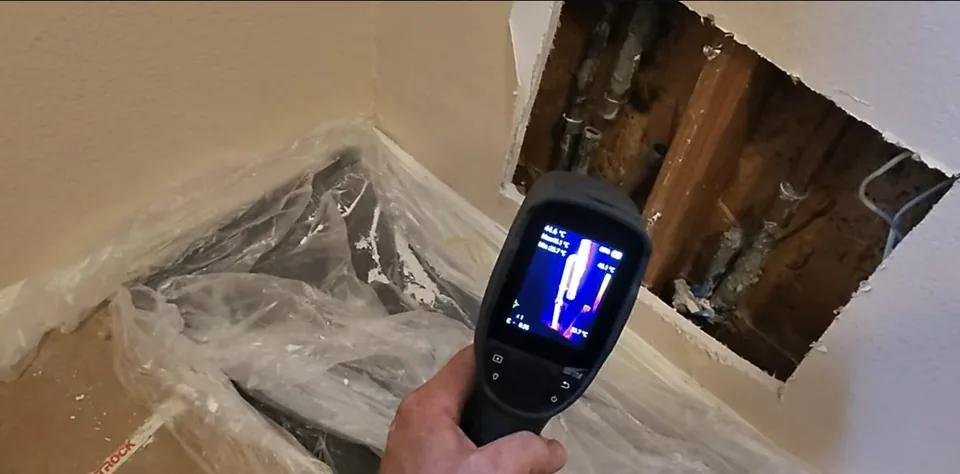
On an upper floor the usual sources are a shower pan, a toilet seal, a supply connection at a vanity, or a waste connection that only leaks when that fixture is used. Which one it is changes what we test.
Under the floor: basements and crawlspaces
Very little plumbing here sits inside a slab. Basements and crawlspaces carry most of it, which puts the majority of pipe in an Ashburn house somewhere nobody looks from one month to the next.
That matters because an unattended leak down there runs for a long time before anyone notices. By the time it shows as a smell upstairs or a damp wall, it has usually been going for a while.
Pooled call data bears this out: under-house and crawlspace leaks are among the higher-converting calls in this category, which is another way of saying that when someone finally looks, there is usually something genuinely there.
If you have a basement or crawlspace you have not been into this year, that is worth ten minutes with a flashlight.
Copper that develops pinholes
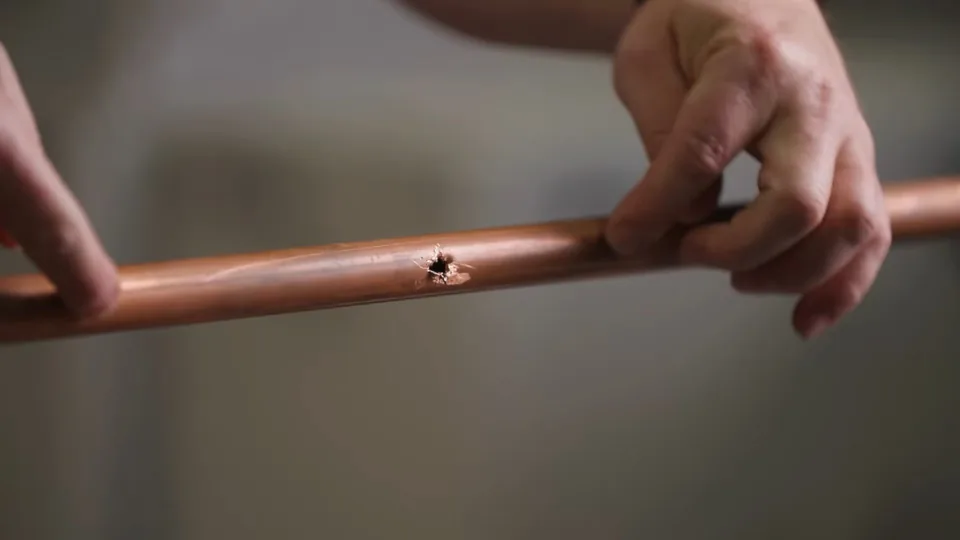
Copper supply line does not usually fail at a joint. It fails as a pinhole in the pipe wall, and a pinhole can weep for months before it produces anything you would notice.
The tell is a small green or white deposit on the outside of the pipe, where mineral content has dried at the escape point. On an exposed run in a basement you can often spot this by eye.
One pinhole is a repair. Several across different runs usually means the pipe has reached the end of its service life, and at that point the conversation is about whole-house pipe replacement rather than patching.
The line between the meter and the house
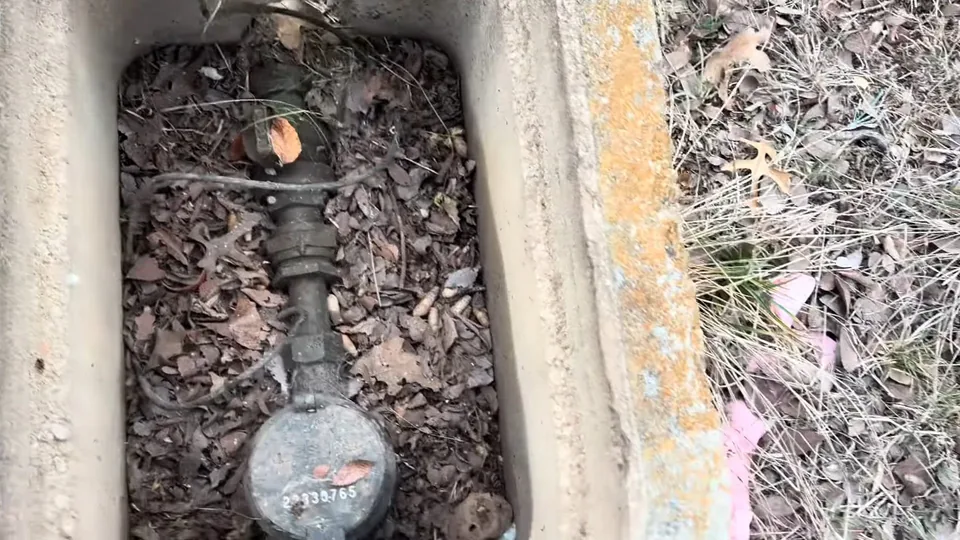
Not every leak is inside. The water service line runs underground across the yard from the meter to the house, and when it leaks the only evidence above ground may be a patch of grass that stays greener than the rest.
This is a common call and a meaningful one, because the homeowner is usually responsible for the section from the meter to the building. It is also the category where older plastic service line matters most.
Ashburn's oldest neighborhoods fall inside the polybutylene window, and poly fails at fittings without warning. Where a service line is poly and has already failed once, replacement is normally the better answer than a second repair.
A buried line that will not localize
Some underground leaks cannot be pinpointed acoustically, usually because the ground is saturated or the line runs under hardscaping that carries the sound away.
When that happens we say so rather than keep charging for detection. The honest options are a pressure test to confirm the section, then either excavation at the most likely point or a full line replacement.
Irrigation, pools and roof water
Three categories sit at the edge of plumbing and get confused with indoor leaks often enough to be worth separating.
How each one presents
- Irrigation and sprinkler: a wet zone that appears when the system runs and dries between cycles, often with a drop in pressure on that zone
- Pool and spa: a falling water level faster than evaporation explains, with wet ground near the equipment pad or the return lines
- Roof and gutter: water appearing after rain rather than after water use, which is the clearest single distinction between the two causes
If the water only appears when it rains, it is almost certainly not a supply leak. If it appears regardless of weather, it almost certainly is.
Timing is the diagnostic. Before calling anyone, note whether the damp follows rainfall, follows irrigation, or follows nothing at all.
Gas is a different search entirely
Gas leak detection uses different equipment and a different procedure, and the first step is not diagnostic at all.
If you smell gas, leave the building and call from outside. Do not operate switches, and do not look for the source yourself.
Once the property is safe, the work is pressure testing and combustible gas detection on the line. That is handled on our gas line repair service rather than here, because the equipment and the safety sequence are not the same.
Multi-tenant buildings, and whose leak it is
On a commercial property the question is usually not just where the leak is but whose it is. In a multi-tenant building a leak presenting in one unit frequently originates in another.
Pooled call data shows commercial leak detection converts less often than residential, and the reason is usually access: the work needs coordinating between a tenant, a landlord and sometimes a managing agent before anyone can start.
Having a clear record of which line serves which unit removes most of that delay. Our commercial property plumbing work covers that side of it.
After we find the leak: repair is priced separately
Detection and repair are separate pieces of work, and we price them separately for a reason: until the leak is located, nobody can honestly tell you what fixing it involves. The consultation that follows the inspection is where that gets settled.
The usual outcomes
- A single fitting or short section replaced, which is the most common and the smallest job
- A pinhole repair on an exposed run, often done the same visit
- A reroute, where replacing a buried or inaccessible section costs more than running a new line by a better path
- A recommendation to replace the run or the system, where the same line has now failed more than once
- A referral onward, where what we find is not a plumbing leak at all
That last one happens and we would rather say it than invent work. If the water is coming from a roof, a window detail or groundwater, the fix is not ours and telling you so is the useful answer.
What leak detection costs in Ashburn
There is no published range for detection alone, because the job is scoped by how hard the leak is to find rather than by what the repair turns out to be.
What we can say is the structure. Detection is quoted on arrival once we have seen the property and heard what the symptoms are. The repair is quoted separately once the leak is located.
Where a leak is under a slab or a basement floor, the published range for slab leak detection and spot repair is $1,500 to $4,500, and that figure covers both halves because the two are rarely separable in that situation.
Leak detection questions from Ashburn homeowners
My water bill jumped but I cannot see a leak anywhere. What now?
Start at the meter, because it settles the question in minutes and costs nothing. Turn off every fixture in the house, including anything automatic like an ice maker or an irrigation controller, then watch the meter dial.
If it still creeps, water is leaving the system somewhere. If it is completely still for fifteen minutes, the bill has another explanation and nobody needs to open a wall.
Once a leak is confirmed, the work is narrowing where it is before anything gets cut. That is what acoustic, thermal and pressure isolation are for, and it is what keeps the eventual repair small.
There is a damp patch on my ceiling. How do you find the source without opening the whole wall?
The visible mark is almost never directly under the leak. Water runs along a joist or a pipe until it finds a low point to drop from, so chasing the stain upward tends to produce several holes and no answer.
Thermal imaging reads the wet area rather than the visible stain, and the wet area is a different shape. Combined with isolating one fixture at a time, that usually narrows it to a single connection.
On an upper floor the usual candidates are a shower pan, a toilet seal, a vanity supply connection, or a waste connection that only leaks when that fixture runs. Which one it is changes the test, which is why the diagnosis comes before the opening up.
Which detection method gets used on a concealed leak and why?
Acoustic equipment amplifies the sound pressurized water makes as it escapes, which suits supply lines in walls, under floors and underground. Thermal imaging reads surface temperature differences, which suits hot water lines and wet material behind a finished surface.
Pressure isolation shuts sections in turn to find which one loses pressure, and it is usually how the search gets narrowed to a zone before anything more precise is used. A camera handles waste lines, where there is no pressure to listen for.
Most jobs use two together. Isolation narrows it to a zone, then acoustic or thermal finds the spot within it.
How is leak detection priced when the leak has not been found yet?
Detection and repair are quoted separately, because until the leak is located nobody can honestly tell you what the repair involves. Quoting both at once would mean guessing at one of them.
Detection is quoted on arrival, once we have seen the property and heard which symptoms brought you to call. The repair is quoted once we know what we are fixing and where.
The exception is a leak under a slab or basement floor, where our published range of $1,500 to $4,500 covers detection and spot repair together, because in that situation the two are rarely separable.
Is leak detection something any licensed plumber can do?
Any properly licensed plumber can repair a leak. Locating one that nobody can see is a different matter, and it comes down to equipment and the hours spent using it rather than the license itself.
A plumber without acoustic or thermal equipment will find a concealed leak by opening things up, which works but costs you more in making good afterwards. That is the practical difference worth asking about.
On credentials, two things are required of anyone working here: state trade licensure through DPOR and a Loudoun County business license. DPOR runs a public lookup, so the state side takes a minute to confirm before you book.
Think you have a leak you cannot see?
Tell us what made you suspect it: the bill, a sound, a stain, or a damp smell. Each of those points at a different part of the system.